Coaching with a clear next step
Practice without direction is just more play. The players who climb steadily usually follow a sequence: secure the basics, own the soft game, then learn to make good decisions under pressure. Here's that sequence, and how to find coaching that respects it.
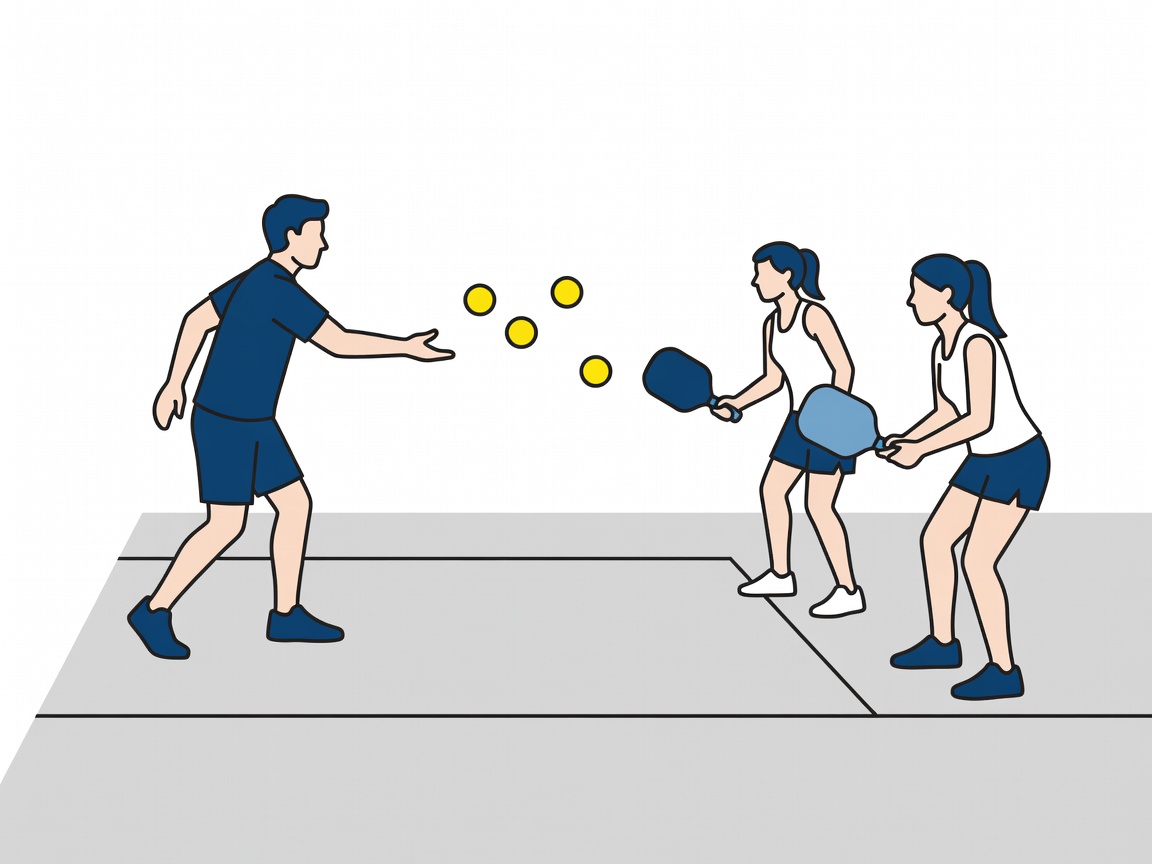
A skills ladder that builds on itself
Coaches label stages differently, but most well-structured programmes move through something close to this order. Skipping steps is the most common reason players plateau around the intermediate level.
Ready position and contact point
Paddle up in front, weight forward, contact the ball out in front of the body. It sounds basic, yet late contact causes a large share of popped-up balls at every level.
Serve and return with depth
A deep, high-margin return buys time to reach the kitchen line. Under the two-bounce rule, the serve and the return must both bounce, so depth here shapes the whole point.
Dinking with purpose
Soft, unattackable shots into the kitchen. The goal moves from "keep it in" to "move my opponent" by changing direction and pace.
The third-shot drop and drive
The serving team's third shot decides whether they can move forward. Learn the drop first, then add the drive as an option, and learn when each fits.
Transition zone and resets
Between the baseline and the kitchen, you'll be attacked. Resetting a hard ball back into the kitchen is the skill that separates steady players from streaky ones.
Hand battles and speed-ups
Fast volley exchanges at the net. Compact swings, paddle position and recognising which ball is actually attackable.
Partnership, stacking and strategy
Communication, covering the middle and stacking so each player keeps a preferred side. This is where doubles becomes a team sport.
Choose the coaching format, not just the coach
A group clinic is efficient for repetition: four to eight players, a single theme, lots of balls. It suits stages one to four on the ladder, where you mainly need volume with feedback.
A private or semi-private lesson pays off when you know what is wrong but can't fix it alone, perhaps a backhand dink that keeps floating or footwork that collapses in transition. One hour of focused correction can save weeks of reinforcing a bad pattern.
Drill-and-play sessions, where a short drill is immediately followed by live games with a constraint ("every third shot must be a drop"), help skills survive contact with real opponents. Video review, even a phone propped on the fence, is one of the cheapest upgrades available.
How to judge a coach before you book
Pickleball's coaching landscape is young and varied. Several organisations offer certification pathways, including the Professional Pickleball Registry (PPR), the International Pickleball Teaching Professional Association (IPTPA) and Pickleball Coaching International (PCI). National bodies run their own coach education too, such as Pickleball England's coaching courses. A certificate shows a coach has studied a teaching framework; it doesn't guarantee they'll be the right fit for you.
USA Pickleball also runs an Ambassador programme. Ambassadors are volunteers who grow local play and often run beginner introductions; they are a great first contact, but not necessarily coaches.
Do they assess before they teach?
A good first session includes watching you play and agreeing on one or two priorities.
Can they explain the "why"?
Technique tips should link to a tactical outcome, such as "this keeps the ball low so they can't attack."
Are groups sorted by level?
Mixed-level clinics slow everyone down. Ask how players are placed, whether by self-rating, DUPR, UTR-P or a coach's evaluation.
Is there safeguarding and insurance?
Especially for junior sessions, check that the coach works under a club or national-body safeguarding policy.
Measuring progress honestly
Ratings systems such as DUPR (Dynamic Universal Pickleball Rating) and UTR-P calculate a level from recorded match results, so they move only when results move. Between rating updates, track simpler signals: how many unforced errors you make on returns, how often you reach the kitchen line safely, and whether you can sustain a ten-ball dink rally to both sides. Those numbers tell you when it's time to climb the next rung.
Sources and further reading
- USA Pickleball: rules and Ambassador programme
- IPTPA: teaching professional certification
- Professional Pickleball Registry (PPR)
- Pickleball Coaching International (PCI)
- DUPR: results-based rating system
- Pickleball England: coach education