Courts that suit your session
The lines are standard everywhere, yet no two venues feel the same. Surface, ball, light, wind and the crowd waiting at the gate all change what a session can do for you. Here's how to read a venue before you commit your week to it.
The court itself, in numbers
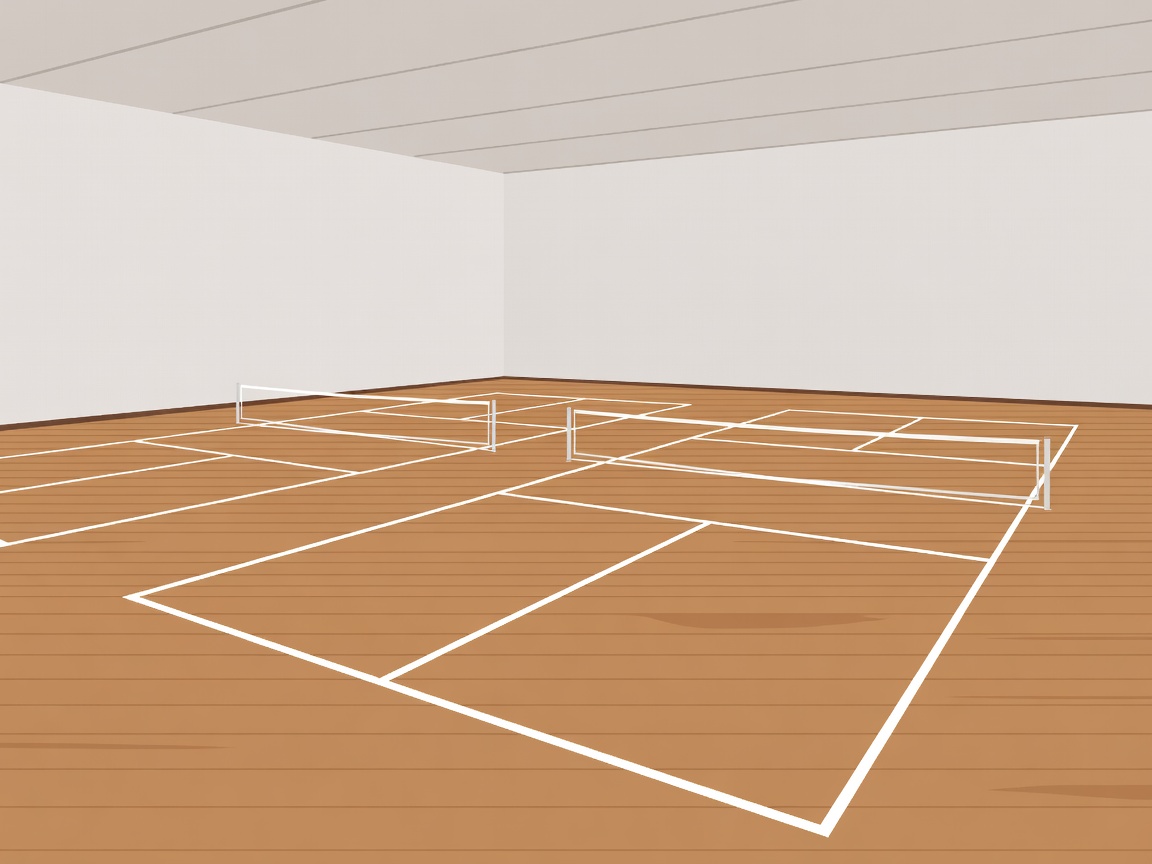
Every regulation court described in the USA Pickleball Official Rulebook, and mirrored by the International Federation of Pickleball and national bodies such as Pickleball England, measures 20 feet wide by 44 feet long, or 6.10 by 13.41 metres. That's the same footprint as a doubles badminton court, which is no accident: when Joel Pritchard, Bill Bell and Barney McCallum improvised the game on Bainbridge Island, Washington, in 1965, they started on a badminton court with the net lowered.
The net stands 36 inches (91.4 cm) at the sidelines and 34 inches (86.4 cm) in the centre. On each side a 7-foot (2.13 m) non-volley zone, the "kitchen", runs the full width of the court. Behind it, a centreline splits the service courts. USA Pickleball guidance suggests a total playing area of at least 30 by 60 feet, with 34 by 64 feet preferred, so players have room to chase lobs and wide angles without colliding with a fence or the next court.
That run-off space is the first thing to check at any venue. A court that is correctly lined but tightly packed changes how you play: you'll stop retreating for lobs and start hesitating on wide balls, which slowly reshapes your habits.
Indoor, outdoor and shared lines
Each setting rewards slightly different skills. A good weekly rhythm often mixes two of them.
Indoor halls and dedicated centres
Stable conditions, no wind and consistent bounce make indoor courts ideal for drilling soft game and resets. Indoor balls usually have around 26 larger holes and play slower and softer. Wooden gym floors can be slick and noisy; purpose-built cushioned surfaces are kinder on knees.
Outdoor hard courts
Acrylic-coated asphalt or concrete is the classic outdoor surface. Outdoor balls typically have about 40 smaller holes, are harder and travel faster. Wind and sun teach you margin and shot selection; low winter temperatures can make balls brittle, so carry spares.
Converted tennis courts
One tennis court can host up to four pickleball courts, which is why so many clubs grew from tennis facilities. Check whether nets are portable, whether lines are permanent or taped, and whether ghost tennis lines confuse your calls.
Shared multi-sport floors
Leisure centres often overlay pickleball on badminton lines. It's an accessible way in, but expect limited hours, shared booking systems and less run-off between courts.
Match the session to the space
Courts are only half the story; how a venue schedules them decides what kind of practice you get. These are the session types you'll meet most often. Names vary by club, so confirm details locally.
Open play
Players queue paddles or names and rotate into games. Great for meeting people and getting reps; ask whether courts are split by level so games stay balanced.
Reserved court time
You book a court for your own group. Best for fixed partners, focused drilling or practice matches before a tournament.
Round robin nights
Organised rotations with changing partners and recorded scores. A gentle bridge between social play and competition.
Coached court blocks
Courts set aside for clinics. Look at the coach-to-player ratio: four to six players per court keeps everyone hitting.
Questions worth asking a venue
How much space surrounds each court?
Compare it with the 30 by 60 foot minimum playing area in USA Pickleball's guidance.
Which ball is standard here?
Ask whether the venue supplies balls from the USA Pickleball approved equipment list or expects you to bring your own.
Are there dividers or barriers between courts?
Barrier netting cuts down on stray balls interrupting rallies and makes busy sessions safer.
What happens in bad weather or after dark?
Lighting quality and an indoor backup plan decide whether your outdoor routine survives autumn.
Sources and further reading
- USA Pickleball: Official Rulebook and court construction guidance
- Pickleball England: national body for England
- International Federation of Pickleball (IFP): international rules alignment
- Bainbridge Island, Washington: birthplace of the game in 1965